
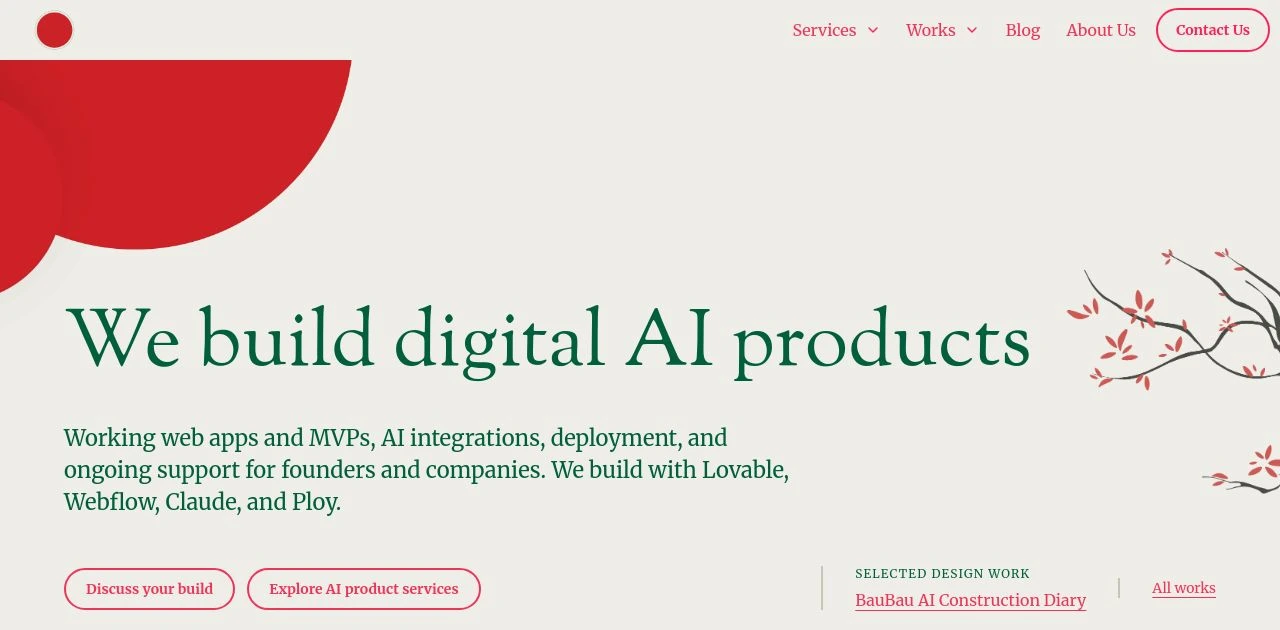
Our website is the example
Kings Landing uses Ploy for its own agency website. The site presents our digital AI product services, selected work, and editorial guides. Its job is to explain what we build, let readers inspect relevant evidence, and give them a direct way to discuss a project.
This is an own-site case study. The business commissioning the work and the business doing it are both Kings Landing. It demonstrates our website implementation and content decisions, not an independent client review or a measured increase in leads.
Keep the brand, connect the pages
The website uses Kings Landing's existing visual language. Sorts Mill Goudy headings, Merriweather prose, warm neutral surfaces, green editorial text, and pink links and controls carry across the site. The red-circle and cherry-branch artwork remains part of the page system.
Rather than treat each new page as another design, the site shares its navigation, footer, and reusable sections. A service page can use the same split hero with a different offer and image. Buyer FAQs share one expandable pattern. These decisions keep new content connected to the brand while leaving room for different page purposes.
The Services page explains the wider build offer. The platform product design guide explains roles, interactions, trust, and workflow decisions. Product case studies describe their own contributions. The Ploy hiring page connects website delivery to that wider experience without suggesting that every portfolio project was built in Ploy.
Make content editable where it repeats
The blog reads its article records from PloyDB at request time. Titles, summaries, Markdown bodies, images, and search metadata live in the content records. A shared article template renders the selected record, rather than requiring a separately authored page for every post.
The public blog listing excludes draft and archived articles. The article route also checks draft status before serving content in a published build. That separates writing and review from the public reading experience. Not every word on the site is CMS-managed; one-off pages and some page sections remain in source code.
Service and published-work records also supply the shared navigation menus. An editorial update and a navigation decision have different roles, but both use the site's established page destinations.
This approach follows Ploy's documented database model. It is evidence of how this website is organized, not a promise that every client's content structure should be identical.
Give readers a clear enquiry path
Service and guide pages explain the subject before sending a reader to Contact. Relevant internal links connect a service to its evidence and connect a guide to the next decision. A reader evaluating Ploy can move between the agency offer, this own-site example, and the agency-hiring checklist.
A useful enquiry includes the existing site, intended audience, required pages, content readiness, and any integration needs. That helps define a first release and its responsibilities. It does not turn an unspecified website request into a fixed-price package.
Connect content to search discovery
The site has page titles and descriptions, canonical URLs, a sitemap, and an AI-readable content index. Relevant pages use structured data for services, articles, breadcrumbs, and visible FAQs. The FAQ component produces its readable answers and FAQ markup from the same content.
These are implementation choices, not proof of search success. Google's AI-search guidance explains that its AI features use the same foundational SEO requirements. The site still needs to be released, crawled, and indexed, and visibility must be measured separately.
Our public pages show the service descriptions, content, and project attribution we want buyers to inspect. We do not present organic ranking, traffic growth, or enquiry improvements as outcomes of this case study.
What this build demonstrates
The website demonstrates a shared brand system, reusable service and content layouts, runtime CMS-backed articles, draft-aware editorial publishing, consistent enquiry destinations, and relevant links between services and evidence. It also demonstrates the distinction between agency services and project-specific contributions.
Those decisions are useful for a company that needs a branded marketing website and an ongoing publishing process. A system involving private application data, third-party actions, or recurring automation needs its own scope and tests. This website is not evidence that Kings Landing has delivered every system Ploy can support.
For a new engagement, we agree the pages, content model, integrations, review process, account arrangement, and support responsibilities before delivery. Start with our Ploy website service, or use the hiring guide to compare a proposed project.